Queer Places:
Neuilly-sur-Seine Old Communal Cemetery, 3 Rue Victor Noir, Neuilly-sur-Seine, Île-de-France, 92200 France
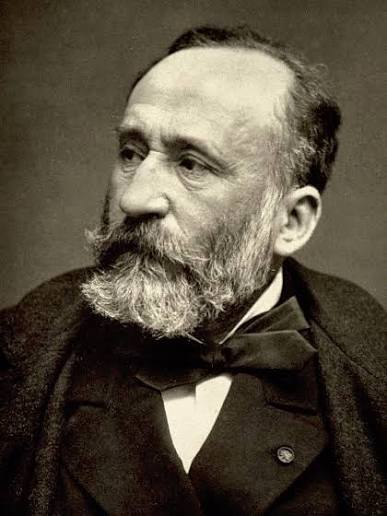 Pierre-Cécile Puvis de Chavannes (December 14, 1824 – October 24, 1898) was a prominent French painter and a leading figure in the Symbolist movement. He is best
remembered for his monumental, allegorical mural paintings that decorated major public institutions in France and abroad, earning him the title of the "painter for
France".
Pierre-Cécile Puvis de Chavannes (December 14, 1824 – October 24, 1898) was a prominent French painter and a leading figure in the Symbolist movement. He is best
remembered for his monumental, allegorical mural paintings that decorated major public institutions in France and abroad, earning him the title of the "painter for
France".
Born in Lyon to a wealthy bourgeois family, Puvis de Chavannes was initially destined for a career in engineering, following in his father’s footsteps. However, he
discovered a passion for art in his early twenties and studied under masters such as Henri Scheffer, Thomas Couture, and Eugène Delacroix.
His work is characterized by a "classicizing" yet avant-garde style—often referred to as proto-Symbolist—which emphasized flat planes of color, simplified forms, and
serene, dream-like atmospheres. Despite his departure from traditional academic perspective, he was highly respected by the French establishment, receiving numerous
public commissions for sites such as the Panthéon, the Sorbonne, and the Hôtel de Ville in Paris. He was also a founding member and president of the Société Nationale
des Beaux-Arts. His influence was immense, touching the work of later Modernist giants including Gauguin, Picasso, and Matisse.
His personal life was marked by a long-term, committed relationship with the Romanian princess Marie Cantacuzène. The couple remained together for approximately 40
years before marrying in 1898, shortly before both of them passed away within months of each other. While he was a significant figure in the artistic circles of the 19th
century and supported many younger, avant-garde artists, records of his life focus on his prolific output, his professional associations, and his long-standing
partnership with Cantacuzène.
The frequent citation of Puvis de Chavannes and Gustave Moreau in the context of homoerotic influence is largely a development of 20th- and 21st-century scholarship.
Modern art historians often re-examine these artists for several reasons:
Scholars often analyze how the treatment of the male nude in the late 19th century shifted away from traditional, hyper-masculine "heroic" tropes. In works by Puvis
de Chavannes, for instance, critics have noted a sense of vulnerability, languor, and a lack of traditional "action" in male figures, which some interpret as a
deliberate challenge to Victorian ideals of masculinity.
Both Moreau and Puvis de Chavannes were central to the Symbolist movement, which prioritized "dreams and visions" over realism. This inherent ambiguity allowed them
to explore themes of desire, beauty, and the body in ways that were intentionally detached from conventional narrative or morality.
Queer theory in art history has sought to uncover "alternative narratives" within the work of these painters, looking at the ways their aesthetic choices—such as
muted palettes, dream-like settings, and focus on physical beauty—might have provided a coded space for homoerotic expression that was not explicitly labeled as such in
the 1890s.
References:
- https://en.wikipedia.org/wiki/Claude_Phillips
- https://pressbooks.openeducationalberta.ca/19thcenturyart/chapter/chapter-7/
- https://academic.oup.com/arthistory/article-abstract/43/1/154/7277609?redirectedFrom=PDF
Support this project
This website is a passion project researched, developed, and funded entirely by me. If you find the content valuable and would like to help support the ongoing research and hosting costs, any contribution is deeply appreciated.
Thank you for keeping this independent resource alive!
My books on Amazon: Elisa Rolle's books
BACK TO HOME PAGE